

The Alignment Archive
Updated Aug 20, 2026
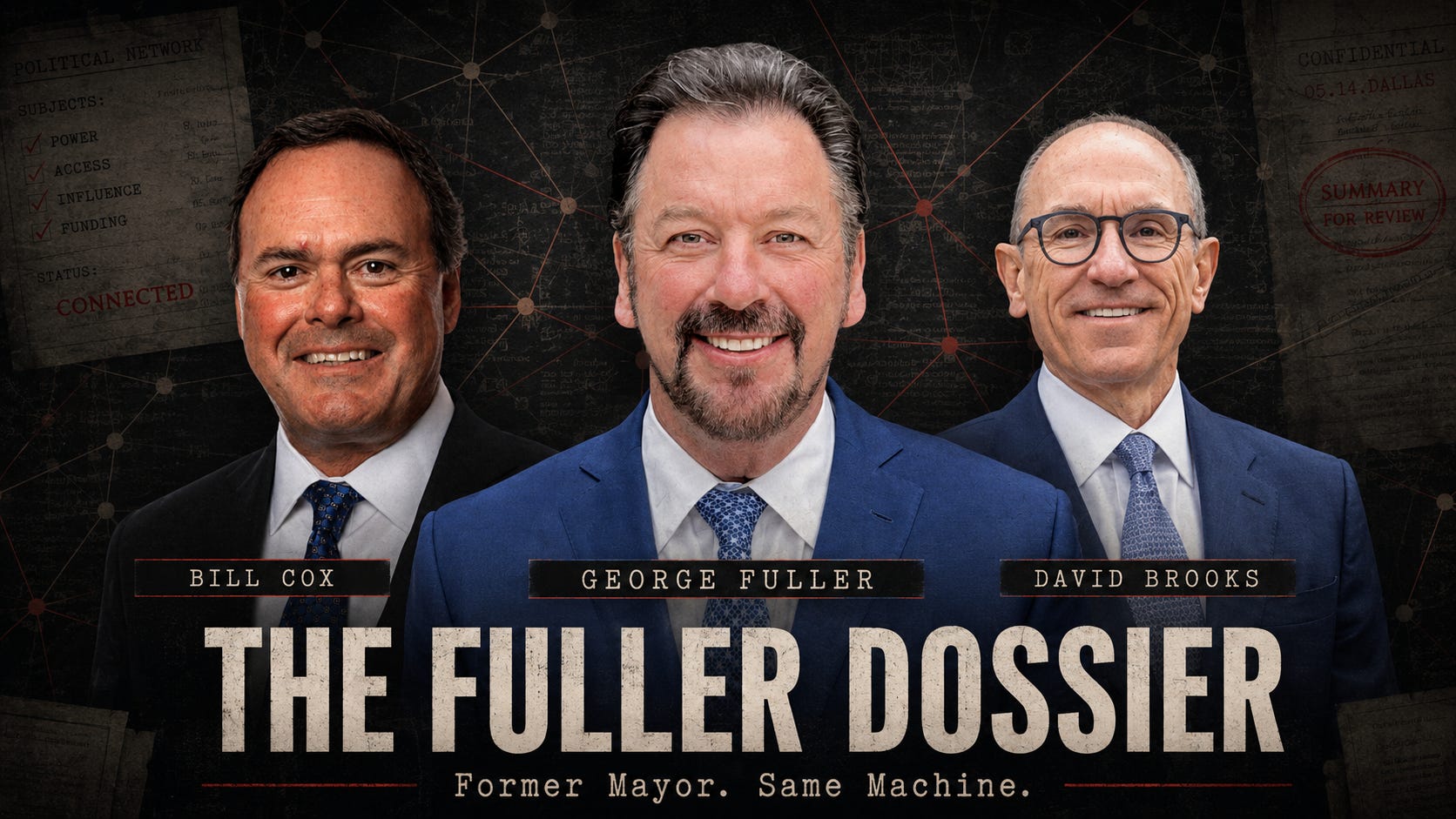
George Fuller left the McKinney mayor’s office in 2025. Normally, that would make him exactly what the title says: the former mayor.
But Fuller kept showing up.
And when I started tracing his history in McKinney, something became clear pretty quickly: his relationship with the city’s development machinery began long before he became mayor, and it didn’t end when he left office.
Fuller came out of the development world. He moved into public development governance. Then he became mayor. And when his mayoral term ended, he moved right back into development governance.
That was the first thing that caught my attention.
Then the same names started showing up around him.
1. Before Fuller Was Mayor, There Was Adriatica
Long before George Fuller occupied the mayor’s office, he was deeply involved with Adriatica, the 46-acre Croatian-inspired mixed-use development in McKinney.
An official 2012 City of McKinney approval letter for the St. Paul’s Square Lofts site plan is addressed to IBG Adriatica Holdings, Inc., c/o George Fuller. City project records identify Fuller as the applicant connected to that development.
Fuller’s own biography describes him as the managing construction partner for Adriatica. And contemporary reporting from 2013 identified David Brooks and George Fuller as the developers leading the Adriatica town-center project, which had originally been conceived by developer Jeff Blackard.
That gives us an important piece of the relationship much earlier than the political-money trail. Brooks and Fuller were not two people whose paths first crossed in politics years later. Their development histories already intersected at Adriatica.
But Fuller wasn’t only working inside the private development world at the time.
He was also serving on the McKinney Community Development Corporation — MCDC, the city corporation that uses sales-tax revenue to fund community and economic-development projects.
And in October 2012, Fuller became chairman of MCDC.
So before he ever became mayor, Fuller was already occupying two sides of McKinney’s development ecosystem:
Private development: Adriatica
Public development governance: MCDC
That overlap is not proof of misconduct. Developers and business leaders often serve on civic boards.
But remember it.
Because fifteen years later, we end up almost exactly where we started.
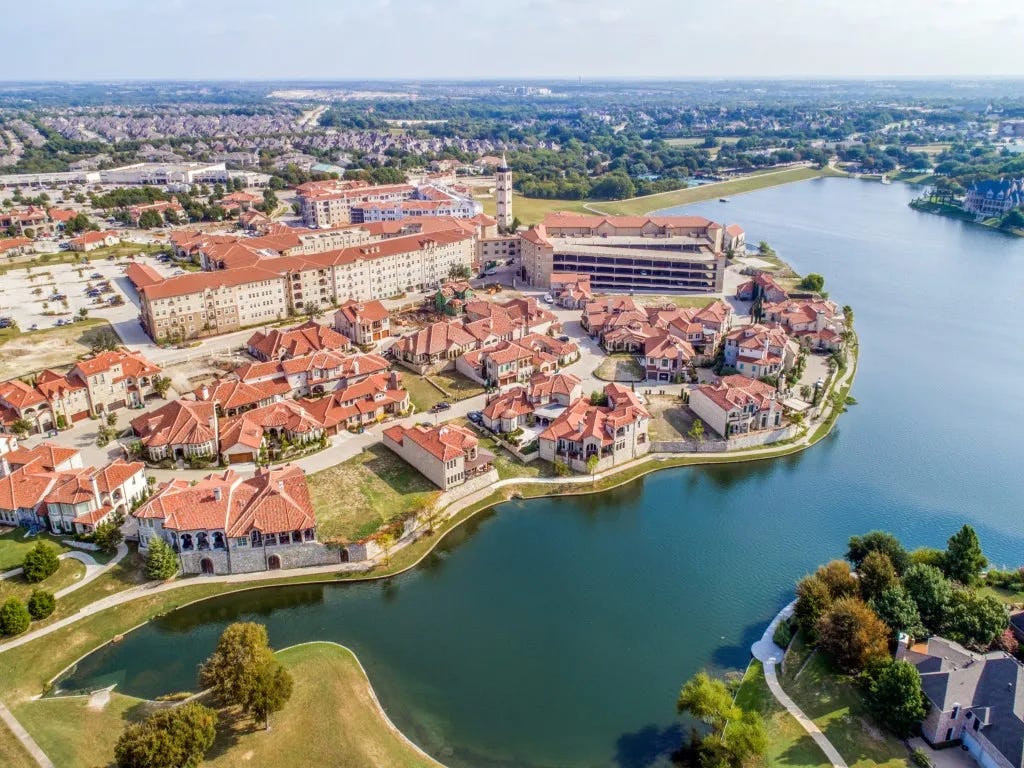
2. Adriatica Runs Into Trouble — and David Brooks Enters the Story
Adriatica was hit hard by the aftermath of the financial crisis.
Independent Bank Group eventually created IBG Adriatica Holdings to acquire distressed Adriatica-related loans and property. According to the bank’s SEC filings, those troubled loans had a face value of roughly $23 million and were acquired for approximately $16.25 million.
Then another entity entered the picture:
HIMALAYAN VENTURES, L.P.
In 2012, IBG Adriatica sold Himalayan Ventures approximately five acres of undeveloped Adriatica property, together with an interest in common areas, for roughly $3.5 million.
Then, in December 2013, IBG Adriatica sold Himalayan Ventures the remainder of its Adriatica real-estate holdings. Those holdings included a retail center, 32 residential lots, a planned medical-office site, undeveloped land, a parking garage and associated spaces.
The price was approximately $11.1 million.
And Himalayan was not simply an unrelated outside developer.
Independent Bank’s SEC disclosures identify Himalayan Ventures as an investment partnership whose principals included David R. Brooks, then chairman and CEO of Independent Bank, along with Vincent Viola, Torry Berntsen, Douglas Cifu and Daniel Brooks.
Because insiders of the bank were participating in the transactions, Independent disclosed them as related-party transactions and described independent review procedures around the sales.
So there is no hidden transaction being exposed here.
What matters is the relationship.
Independent Bank → distressed Adriatica assets → Himalayan Ventures → David Brooks
And Fuller remains in the picture.
3. Fuller and Brooks Were Connected Through Development Before Campaign Money Ever Appeared
This is an important part of the timeline.
David Brooks doesn’t suddenly appear years later as somebody who happened to donate to a politician named George Fuller.
Their worlds were already intersecting inside Adriatica.
In fact, contemporary reporting identified David Brooks and George Fuller together as the developers leading the Adriatica town-center project.
That gives us a much more direct Fuller-Brooks relationship than the ownership records alone. The Himalayan Ventures records then add another layer: Brooks was a principal of the investment partnership that purchased millions of dollars of Adriatica property.
City and state development records also show Fuller acting in connection with Himalayan Ventures projects at Adriatica. In one McKinney development proceeding, Fuller appeared on behalf of Himalayan Ventures. A later Texas development record lists Himalayan Ventures as the owner and George Fuller as the owner/project contact on an Adriatica project.
That gives us a documented relationship chain:
DAVID BROOKS / INDEPENDENT BANK
→ HIMALAYAN VENTURES
→ ADRIATICA
← GEORGE FULLER
But we can now add an even simpler connection above it:
DAVID BROOKS ↔ GEORGE FULLER — Adriatica developers
And all of this predates Fuller’s mayoralty.
That matters when we reach the political-money trail.
4. Fuller Becomes Mayor
George Fuller was elected mayor of McKinney in 2017.
During his years in office, entities connected with the same development ecosystem continued working with McKinney’s economic-development apparatus.
One example is Himalayan Ventures itself.
McKinney Economic Development Corporation records identify Project E21013 — Himalayan Ventures, with an approved amount of:
$552,000
The agreement concerned additional development at Adriatica, and later MEDC financial reports show the full amount as expended.
Again, economic-development incentives are common. Cities offer them to companies and developers in exchange for investment, construction, jobs, taxable property or other promised public benefits.
The existence of the incentive is not the allegation.
The interesting part is that while this development relationship is continuing, David Brooks also enters Fuller’s political-finance record.
5. Brooks Funds Fuller
George Fuller’s official 2021 campaign-finance report records:
David R. Brooks — $2,500
The filing identifies Brooks as president of Independent Financial.
Now put that beside the earlier history.
Brooks and Fuller had already been identified together as developers leading Adriatica. Brooks was tied to Independent Bank and Himalayan Ventures. Himalayan was tied to Adriatica. Fuller had been working with Adriatica/Himalayan-related development before becoming mayor. And while Fuller was mayor, Brooks contributed to Fuller politically.
There is no evidence in these records that the contribution bought an action or influenced an incentive decision.
But the relationship is real.
And it becomes more interesting four years later.
6. Enter Bill Cox
When Fuller reached the end of his mayoral tenure, Bill Cox ran to succeed him.
Cox was not coming into McKinney government from outside its development world. He is a principal of Carey Cox Company, a commercial-real-estate firm specializing in Collin County.
He had also spent years inside McKinney’s planning system, including serving as chairman of the Planning & Zoning Commission.
And George Fuller endorsed him for mayor.
So the transition wasn’t simply:
Fuller leaves → unrelated new mayor arrives.
It was:
Fuller → endorses Cox → Cox becomes mayor.
Then David Brooks appears again.
7. Brooks Funds the Successor
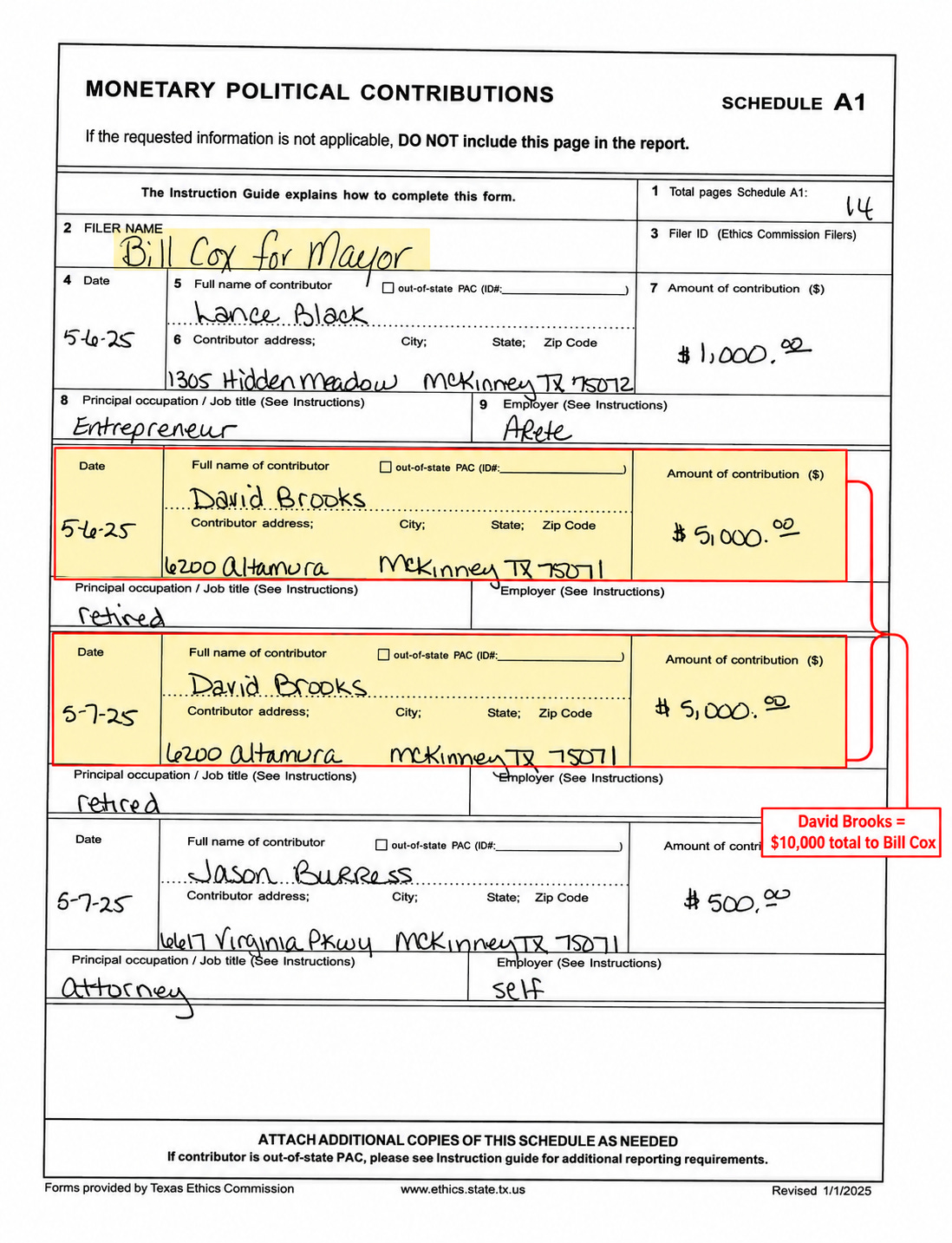
Bill Cox’s 2025 campaign-finance records show two contributions from David Brooks on consecutive days:
May 6 — $5,000
May 7 — $5,000
Total: $10,000
Now we have one of the cleanest bridges in the network.
Brooks financially supported George Fuller.
Fuller later endorsed Bill Cox.
Then Brooks financially supported Bill Cox.
None of that is illegal on its face. Campaign donors often support multiple politicians who share their priorities.
But it tells us something important about continuity.
The office changed hands. The surrounding relationships did not disappear.
8. Adriatica and MCDC Intersect Again
There is another piece of the timeline worth adding here.
In August 2022, the McKinney Community Development Corporation approved slightly more than $98,000 for an amphitheater and park-improvement project requested by the Adriatica Master Association. The funding represented 100 percent of the reported project cost.
At the time, George Fuller was mayor.
Fuller publicly discussed the project and described his own involvement as that of an independent, unpaid consultant.
That distinction matters. The available record does not establish that MCDC gave George Fuller $98,000 or that Fuller personally received the grant money.
What it establishes is that MCDC funded improvements within Adriatica, a development with which Fuller had longstanding business ties, while Fuller was mayor and publicly described himself as an unpaid consultant connected with the project.
That is the documented intersection.
9. Then Fuller Comes Back
This is the part of the Fuller story that may be the most revealing.
Fuller leaves the mayor’s office in 2025.
By October 1, 2025, the City of McKinney’s official Board and Commission Member List shows Fuller back on the:
McKINNEY COMMUNITY DEVELOPMENT CORPORATION
with a term expiring in 2027.
The same institution where we found him serving more than a decade earlier.
And subsequent MCDC leadership records identify Fuller as chairman again.
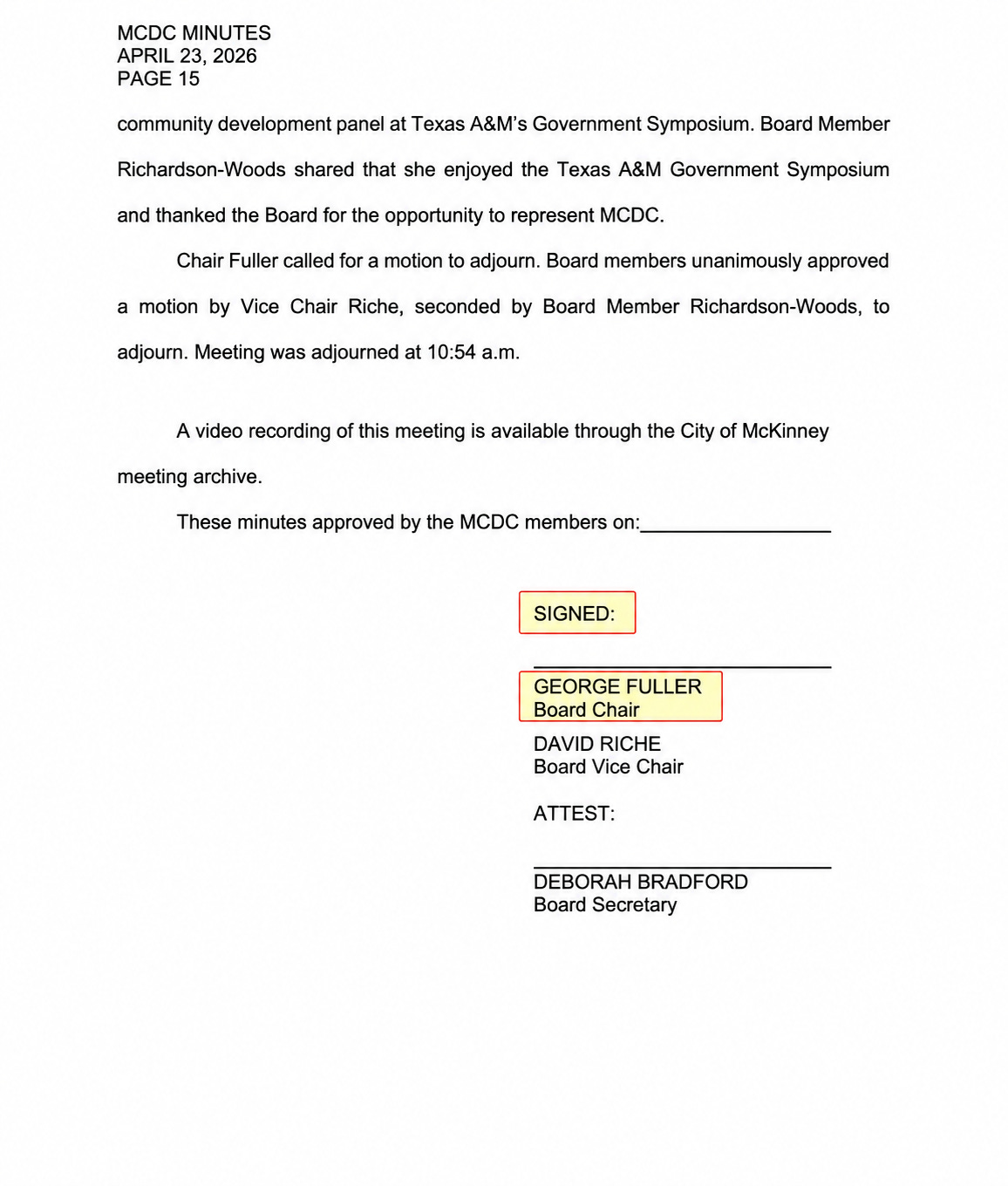
Think about the loop:
Developer → MCDC → MCDC Chairman → Mayor → leaves office → MCDC → MCDC Chairman
That is an unusually durable institutional path.
Calling George Fuller simply the “former mayor” leaves out most of the story.
The mayor’s office was one stop inside a much longer relationship with McKinney’s development system.
10. Now Look at the Whole Fuller Network
Once you stop looking at these events individually, the structure starts becoming visible.
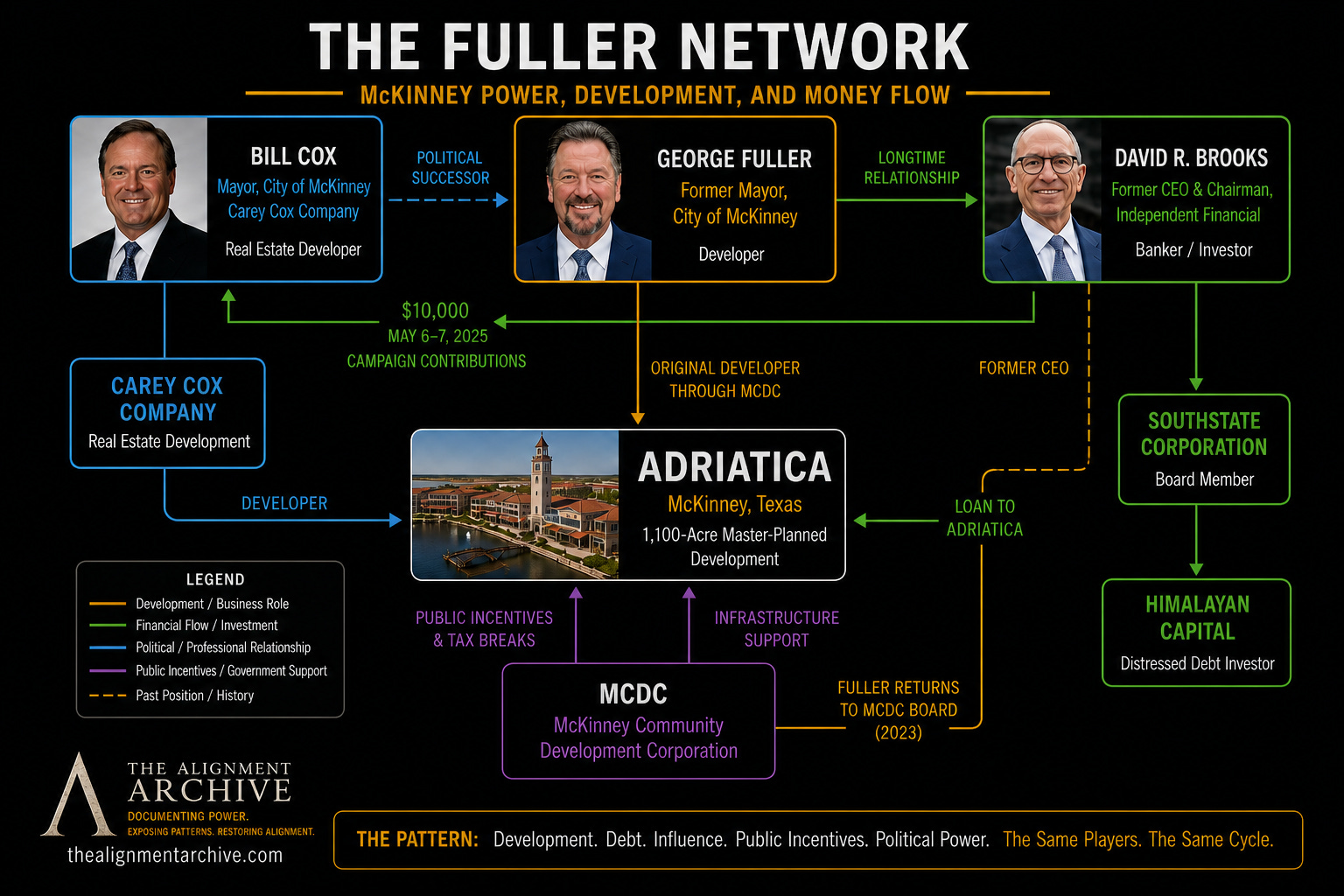
THE CORE CHAIN
We can now start with the most direct relationship:
GEORGE FULLER ↔ DAVID BROOKS
Adriatica developers
Then the ownership and investment trail:
DAVID BROOKS
→ HIMALAYAN VENTURES
→ ADRIATICA PROPERTY
And Fuller remains connected to Adriatica development throughout the same period.
Then politics enters the chain:
BROOKS → $2,500 → FULLER
Fuller leaves office and endorses Cox:
FULLER → COX
Then:
BROOKS → $10,000 → COX
Cox becomes mayor.
And simultaneously:
FULLER → MCDC → CHAIRMAN
MCDC itself had also funded an Adriatica improvement project while Fuller was mayor.
That is not evidence of a secret conspiracy.
It is something much easier to document:
institutional continuity.
11. And Fuller Isn’t the Only Recurring Node
Once we started following the network outward, other names began appearing across the same categories.
McKinneyTEAM
McKinneyTEAM is a longstanding local political organization that has supported George Fuller, Bill Cox and Rick Franklin over different election cycles.
And one of the people associated with McKinneyTEAM’s leadership?
David Brooks.
So Brooks now appears across several different layers:
Independent Bank
Himalayan Ventures
Adriatica
Adriatica development alongside Fuller
Fuller campaign financing
Cox campaign financing
McKinneyTEAM
That makes Brooks one of the strongest connective nodes in the entire map.
12. Rick Franklin
Current Mayor Pro Tem Rick Franklin has his own recurring development résumé.
Franklin is a longtime commercial-real-estate broker. Before his current City Council role, he served on both McKinney Planning & Zoning and the McKinney Economic Development Corporation.
He also contributed $2,500 to Bill Cox’s mayoral campaign.
So the current McKinney leadership alone includes:
Mayor Bill Cox — commercial real estate / former P&Z chair
Mayor Pro Tem Rick Franklin — commercial real estate / former P&Z / former MEDC
And sitting over at MCDC:
Former Mayor George Fuller — developer / former MCDC chair / current MCDC chair
Again, none of those backgrounds makes someone corrupt.
But this is why describing McKinney politics without describing its development class leaves out half the picture.
13. Another Development-Money Cluster
Cox’s campaign records produced another interesting cluster.
Four contributing entities used the same McKinney address at 6850 TPC Drive:
Craig Drive 2 LP — $2,500
CB Glen Developer LLC — $10,000
Three Angel Investments LLC — $10,000
Rowlett Creek Mgmt LLC — $2,500
Combined: $25,000
State development records also connect that address with The Glen Office and developer Nick Mourton. Mourton himself contributed to Cox.
Then The Glen Office appears in MEDC’s economic-development incentive records.
So once again we see the same basic categories intersecting:
development → public economic-development program → political financing
That does not tell us the relationships were improper.
It does tell us where influence, development and politics overlap.
14. The Public-Money Layer
The Brooks-connected network also appears repeatedly inside McKinney’s economic-development spending.
Among the projects we identified:
Independent Bank — $5.381 million approved
Independent Bank 2020 — $2.838 million approved
Himalayan Ventures — $552,000 approved
$1.051 million
There is also the separate MCDC project discussed above: slightly more than $98,000 for improvements requested by the Adriatica Master Association.
These were not checks dropped into somebody’s personal bank account. They were economic-development agreements connected to real projects and contractual requirements.
That distinction matters.
But so does the scale.
Entities associated with the same people showing up in the political network were also participating in millions of dollars of public economic-development programs.
That is part of the system residents deserve to understand.
15. So Is This Corruption?
Based on the records reviewed so far:
We cannot say that.
We have not established bribery, a quid pro quo, criminal self-dealing or some secret illegal agreement between Fuller, Brooks and Cox.
We also have not established that Fuller personally received the 2022 MCDC Adriatica grant. And the Himalayan Ventures transactions discussed above were disclosed by Independent Bank as related-party transactions, with the company describing independent review procedures around those sales.
And that is not what this dossier is alleging.
What the records do show is a long-running overlap among McKinney’s development interests, banking and investment relationships, political financing, civic organizations, planning institutions and elected leadership.
Every individual mechanism can be perfectly legal.
Campaign contributions can be legal. Development incentives can be legal. Civic appointments can be legal. Developers can serve on boards. Politicians can endorse successors. Former mayors can return to appointed positions.
But legality doesn’t answer every question about power.
When the same relatively small group of people repeatedly moves through those systems, a different question becomes worth asking:
Who has enduring access to the machinery?
16. Former Mayor Doesn’t Mean Former Power
George Fuller keeps being described as McKinney’s former mayor.
Technically, that’s accurate.
But institutionally, it may be the least interesting thing about him.
His longer trajectory looks like this:
Adriatica developer → MCDC → MCDC Chairman → Mayor → political endorser → MCDC → MCDC Chairman
And around that path sit bankers, developers, PACs, campaign contributors, planning officials and economic-development organizations that repeatedly intersect.
One of the people documented beside Fuller near the beginning of that trajectory — David Brooks — also appears repeatedly farther down the timeline: as an Adriatica developer, Independent Bank executive, Himalayan Ventures principal, Fuller campaign contributor and Cox campaign contributor.
Maybe Fuller never “left” McKinney power because the mayor’s office was never the entirety of his power in the first place.
That leaves a much bigger question than who won the last election:
When the politicians change but the network survives, who actually holds power?
That’s the part worth watching.
🥧
Update: The 2022 Adriatica Conflict Question
The deeper question around George Fuller is no longer whether his connection to Adriatica was merely historical.
It was not.
In 2022, while Fuller was serving as mayor of McKinney, an official Texas Department of Licensing and Regulation filing listed George C. Fuller as the owner and contact for a new Fuller Contracting Office project inside Adriatica, with an estimated construction cost of approximately $800,000.
That same year, Fuller was also publicly described as being directly involved in an Adriatica improvement project that received public funding through the McKinney Community Development Corporation.
In September 2022, Community Impact reported that Fuller described his role in that project as an “independent, free consultant.” The project involved improvements to Adriatica’s Harbor Park and amphitheater area.
The McKinney Community Development Corporation approved just over $98,000 for the project through Adriatica Master Association.
That matters because the record now places several facts in the same period:
Fuller was the sitting mayor.
He had an active private business and property presence inside Adriatica.
He was personally involved as an unpaid consultant on the improvement project.
And the association overseeing that project received public development funding from MCDC.
Fuller was also present at MCDC meetings involving the project, although he was not serving as an MCDC voting board member at the time and the records reviewed so far do not show him casting a vote on the grant.
There is one additional piece that remains unresolved.
George Fuller is currently listed as President and Director of Adriatica Master Association, the same association that received the 2022 MCDC funding.
What has not yet been established is when Fuller assumed that officer role.
The Alignment Archive is currently seeking the association’s 2021–2022 filing history and Public Information Reports to determine whether Fuller was already serving as President, Director, or another officer before or during the 2022 grant period.
That distinction matters.
If Fuller held an officer role in the grant-recipient association at the same time he was mayor, maintained an active private business interest inside Adriatica, and participated in the project as a consultant, the conflict and disclosure questions become substantially more significant.
But the evidence does not yet establish that timeline.
Nor does the existing record, by itself, establish illegal self-dealing, bribery, or a statutory conflict of interest.
What it does establish is a much tighter overlap between public office, private development, association governance, and publicly funded improvements inside the same development than was previously visible.
That is why the historical officer record matters.
And that is the receipt we are still looking for.
DOCUMENT NOTE
This dossier is based on public City of McKinney records, MCDC and MEDC records, campaign-finance disclosures, Texas development records, contemporary reporting and SEC filings. The relationships described above do not by themselves establish corruption, bribery, quid pro quo or other unlawful conduct. Economic-development incentives and grants described here should not be interpreted as personal payments to associated individuals unless the underlying record specifically establishes such a payment. Documented relationships are presented as documented relationships; motive should not be inferred from association alone.
FIELD STATUS: Documented relationships include Fuller ↔ Adriatica; Fuller ↔ Brooks in Adriatica development; Brooks ↔ Himalayan Ventures; Himalayan Ventures ↔ Adriatica property; Brooks → Fuller campaign contribution; Fuller → Cox endorsement; Brooks → Cox campaign contributions; MEDC → Himalayan Ventures incentive; MCDC → Adriatica Master Association project; and Fuller → MCDC after leaving the mayoralty.
Inference: The recurrence of the same people and entities across development, finance, campaign support and public-development institutions is evidence of institutional continuity. It is not, by itself, evidence of corruption, illegality, quid pro quo or improper personal financial benefit.
The Archive will update this file if additional primary records strengthen — or contradict — that interpretation.